In the Name of Allah. And may Salat (praise) and Salam (peace, safety and security) be upon the Messenger of Allāh. O Allah! Open for me the doors of Your Mercy!
There is no deity except Allah, alone without a partner. To Him belongs the Dominion, and to Him belongs all praise. He gives life and death, and He has power over everything.
The Messenger of Allah سُبْحَانَهُوَتَعَالَى ﷺ was sent as a mercy for mankind. He cared deeply for his ummah — including those who would come long after him. Sending abundant ṣalawāt (peace and blessings) upon him is one way we show our love and respect.
1. He ﷺ cried for us
ʿAbdullāh b. ʿAmr b. al-ʿĀaṣ (radiy Allāhu ʿanhumā) reported that the Prophet ﷺ recited the statement of Allah سُبْحَانَهُوَتَعَالَى – Exalted and Majestic is He – about Ibrāhīm (ʿalayhis-salām): ‘My Lord! They have caused many people to go astray. So whoever follows me is with me, and whoever disobeys me [—then surely You are All-Forgiving, Most Merciful],’ and ʿĪsā (ʿalayhis-salām) said: ‘If You punish them, they belong to You after all. But if You forgive them, You are surely the Almighty, All-Wise.’ (5:118)
He ﷺ then lifted his hands and weeping, he invoked, “O Allah سُبْحَانَهُوَتَعَالَى! My ummah, my ummah!” Thus, Allah سُبْحَانَهُوَتَعَالَى – Exalted and Majestic is He – said: “O Jibrīl, go to Muḥammad. Even though your Lord has full knowledge, ask him: What is making you weep?” So Jibrīl came to him and asked him. The Prophet ﷺ informed him about what he had said, even though He (subḥānahū wa taʿālā) had full knowledge of it. Allah سُبْحَانَهُوَتَعَالَى sent Jibrīl down with the glad tidings of, “Muḥammad, surely we will please you in regards to your Ummah and we will not cause you grief.”
Source: Muslim.
2. He ﷺ made duʿā’ for us in every ṣalāh
ʿĀ’ishah (raḍiy Allāhu ʿanhā) said: When I saw the Prophet ﷺ in a good mood, I said, “O Messenger of Allah سُبْحَانَهُوَتَعَالَى, supplicate to Allah سُبْحَانَهُوَتَعَالَى for me.” So, he said, “O Allah سُبْحَانَهُوَتَعَالَى, forgive ʿĀ’ishah for her past and future sins, and for what she did in private and in public.” ʿĀ’ishah (raḍiy Allāhu ʿanhā) laughed so much that her head fell into her lap. The Prophet said to her, “Does my supplication make you happy?” She said, “Why would your supplication not make me happy?” The Prophet said, “By Allah سُبْحَانَهُوَتَعَالَى, it is my supplication for my ummah in every ṣalāh.”
Source: Ibn Ḥibbān.
3. He ﷺ remembered his ummah on Eid
It is reported in a ḥadīth that of the two animals the Messenger of Allah سُبْحَانَهُوَتَعَالَى ﷺ slaughtered, one was “on behalf of his ummah, for whoever testified to the oneness of Allah سُبْحَانَهُوَتَعَالَى and testified that the Messenger of Allah سُبْحَانَهُوَتَعَالَى ﷺ had conveyed the message.”
Source: Ibn Mājah.
4. He ﷺ longed to see us
He ﷺ once said: “I wish to see my brothers!” The companions asked him: “O Messenger of Allah سُبْحَانَهُوَتَعَالَى, are we not your brothers?” He ﷺ replied: “You are my companions, but my brothers are those who have not yet come in the world. I will welcome them at the hawḍ (fountain).”
Source: Nasā’ī.
5. Meeting him ﷺ on the Day of Judgement
Anas (raḍiy Allāhu ʿanhu): O Messenger ﷺ, will you intercede for me on the Day of Judgement?
The Messenger ﷺ: I will do so.
Anas: O Messenger of Allah سُبْحَانَهُوَتَعَالَى, where will I look for you?
The Messenger ﷺ: First, look for me on the ṣirāt (bridge).
Anas: What if I do not find you on the ṣirāt?
The Messenger ﷺ: Look for me by the mīzān (scale of deeds).
Anas: What if I do not find you by the mīzān?
The Messenger ﷺ: Then look for me at the ḥawḍ (fountain); I will certainly be found in these three places.
Source: Tirmidhī.
6. He ﷺ saved his special duʿā’ for us
On the Day of Judgement, the other messengers will say: ‘Myself, myself’, whereas the Messenger of Allah سُبْحَانَهُوَتَعَالَى ﷺ – after praising Allah سُبْحَانَهُوَتَعَالَى with a unique litany of praise – will be given the opportunity to ask and he ﷺ will say: ‘My ummah, my ummah’. Unlike the other messengers who had their exclusive duʿā’ accepted for them in this world, the Messenger ﷺ reserved his duʿā’ for us: he will intercede for us on the Day of Judgement.
Source: Bukhārī.
Our love for him ﷺ
“Among the strongest in love for me in my ummah will be those who will come after me. Every one of them will wish to catch a glimpse of me even at the cost of his family and wealth.”
Source: Muslim.
Kids remember: The Prophet ﷺ loved and cared for his ummah. Let’s send peace and blessings upon him, learn his beautiful example, and practise his kindness every day.
“I have not seen anything more beautiful than the Messenger of Allah سُبْحَانَهُوَتَعَالَى. It was as though the sun shone from his face.”
Source: Tirmidhī.
A Detailed Description
When asked by her husband to describe their recent visitor, Umm Maʿbad (raḍiy Allāhu ʿanhā) described our beloved Prophet ﷺ as follows:
“I saw a man who is distinctly handsome with a radiant face. He is well-built, neither blemished by a big belly nor disfigured by an unusually small head.
He is handsome and well-proportioned. His eyes are jet-black, his eyelashes long, and there is hoarseness in his voice. His neck is long, his beard dense, and his eyebrows perfectly close.
When he is silent, he is enveloped in an aura of dignity; and when he speaks, he rises in splendour and glory. He is the most beautiful and most striking of people from far; the most handsome and splendid from close.
He is a gifted orator whose words are neither too few nor too many: it is as though his words are like stringed pearls, sliding off.
He is of medium height, not too tall that you dislike to look at him, nor too short that you disregard him. He is like a branch between two branches: he is the most handsome of the three and the most esteemed of them.
He has companions who honour him: when he speaks, they listen attentively to his words; and when he commands, they hasten to carry out his order. They serve him and gather around him. He neither frowns nor looks down on anyone.”
Source: Ḥākim.
Jābir b. Samurah (raḍiy Allāhu ʿanhu) said:
“I saw the Messenger of Allah سُبْحَانَهُوَتَعَالَى ﷺ on a night when the moon was full, and he was wearing a red garment. I began to look at him and then look at the moon. By Allah سُبْحَانَهُوَتَعَالَى, he was in my eyes more beautiful than the moon!”
Before we begin, let’s remember the blessings of ʿumrah. These five reminders help our family prepare with grateful hearts, sincere intentions and hope in Allah سُبْحَانَهُوَتَعَالَى’s mercy.
1. A Means of Forgiveness
The Messenger of Allah سُبْحَانَهُوَتَعَالَى ﷺ said, “ʿUmrah to ʿumrah is an expiation for what is between them, and the ḥajj mabrūr has no reward except Paradise.”
Source: Bukhari.
ʿUmrah is a beautiful opportunity to seek Allah سُبْحَانَهُوَتَعَالَى’s forgiveness and draw closer to Him. As a family, we can ask Allah سُبْحَانَهُوَتَعَالَى to forgive our mistakes and help us return home with better habits.
2. Erases Poverty and Sins
The Messenger of Allah سُبْحَانَهُوَتَعَالَى ﷺ said, “Perform ḥajj and ʿumrah regularly. Performing them regularly removes poverty and sins just as the blacksmith’s furnace removes impurities from iron.”
Source: Aḥmad.
Think of a blacksmith using the heat of a furnace to purify iron. This powerful picture reminds us to have hope in Allah سُبْحَانَهُوَتَعَالَى’s generosity and forgiveness, even when our worries feel heavy or our mistakes seem great.
3. The Pilgrims Are the Guests of Allah سُبْحَانَهُوَتَعَالَى
The Messenger of Allah سُبْحَانَهُوَتَعَالَى ﷺ said, “The warrior in the path of Allah سُبْحَانَهُوَتَعَالَى, the pilgrim, and the person performing ʿumrah are the delegation of Allah سُبْحَانَهُوَتَعَالَى. He invited them so they responded to Him; they asked Him, so He gave them.”
Source: Nasā’ī.
A delegation is a group of honoured guests travelling for a special purpose. If human rulers welcome their guests with honour and generosity, imagine the generosity of the Lord of all creation! We can approach this journey with gratitude and make heartfelt duʿā.
4. The Greater the Effort, the Greater the Reward
The Messenger of Allah سُبْحَانَهُوَتَعَالَى ﷺ said to ʿĀ’ishah (raḍiy Allāhu ʿanhā) about her ʿumrah, “Your reward is according to the effort you exert and the money you spend.”
Source: al-Targhīb wa al-Tarhīb.
This is a comforting reminder when the journey feels tiring. The effort we make, the difficulties we meet with patience and the money we spend for Allah سُبْحَانَهُوَتَعَالَى are not lost. We can encourage one another, help anyone who is tired and look forward to Allah سُبْحَانَهُوَتَعَالَى’s lasting reward.
5. ʿUmrah in Ramaḍān — The Reward of Ḥajj With the Prophet ﷺ
The Prophet ﷺ said, “Performing ʿumrah in Ramaḍān is equivalent to performing ḥajj with me.”
Source: al-Targhīb wa al-Tarhīb.
What a wonderful encouragement to worship Allah سُبْحَانَهُوَتَعَالَى in Ramaḍān! This describes the great reward of ʿumrah in this blessed month; it does not replace the obligation of ḥajj.
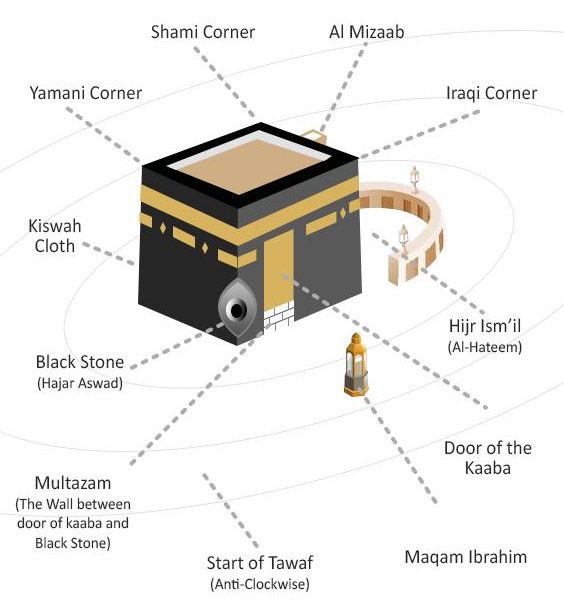
This page helps the children recognise the important places around the Ka'bah before you reach the Mataaf. The labelled photo below helps you identify these places.
Labelled Ka'bah photo
Tap the picture to enlarge it and zoom in.
Labelled photo for family learning.
Kaʿbah key features
Tap the picture to enlarge it and zoom in.
Spot the corners by the Kiswah
The gold embroidery on the Kiswah can help us recognise the Black Stone corner and the Yemeni Corner.
Tap the photo to enlarge and zoom in.
Black Stone corner: Look for the vertical row of five gold medallions, each bearing الله أكبر — Allāhu Akbar — in Arabic calligraphy.
Yemeni Corner: Look for the vertical gold strip running down the corner of the Kiswah.
What are these places?
Ka'bah: The sacred House of Allah سُبْحَانَهُوَتَعَالَى. Muslims all around the world face it in Salah.
Mataaf: The open area around the Ka'bah where people perform Tawaf.
Black Stone (Ḥajar al-Aswad): Located in the corner where Tawaf begins and ends.
Multazam: The area between the Black Stone and the door of the Ka'bah.
Maqām Ibrāhīm: The place associated with Prophet Ibrāhīm عليه السلام. After Tawaf, two rak'ahs are prayed when possible.
Hatīm / Ḥijr Ismāʿīl: The semi-circular area beside the Ka'bah.
Rukn al-Aswad: The corner containing the Black Stone.
Rukn al-Yamānī: The Yemeni corner.
Rukn al-Shāmī: The Levantine / Syrian corner.
Rukn al-ʿIrāqī: The Iraqi corner.
👧 Kids remember: Tawaf starts from the corner of the Black Stone, and the area you walk around is called the Mataaf.
👨👩👧 Family tip: Before going, show this page to the children a few times so they can recognise these places without feeling overwhelmed by the crowds.
Ihram is the special state we enter before beginning Umrah. It is not only the clothing — it is also a state in which certain restrictions begin. Our journey to Makkah begins in Madinah. Follow these steps from getting ready at our hotel to beginning Tawaf.
1. Prepare before Umrah
It is encouraged to perform ghusl (a full-body wash).
Complete personal grooming before entering Ihram: trim or remove underarm and pubic hair, and cut the nails.
Apply fragrance to the body, but not to the Ihram garments, before entering Ihram.
Remember: Finish this preparation before entering the state of Ihram, when the restrictions below begin.
2. Ihram clothing
Our plan: We will most likely put on our Ihram clothes at the hotel in Madinah, inshaAllah.
Men: Wear the two Ihram cloths.
Women: Wear normal modest clothing that properly covers them.
3. Our Miqat: Dhul Hulayfah / Abyar Ali
Our route: As we are travelling from Madinah, our Miqat is Dhul Hulayfah / Abyar Ali. We plan to make our intention to enter Ihram before reaching the Miqat, inshaAllah.
The Miqat is the designated boundary that we must not pass without entering Ihram when travelling to perform Umrah.
The five main Miqat points
Dhul Hulayfah / Abyar Ali
Al-Juhfah / Rabigh
Qarn al-Manazil / Al-Sayl al-Kabir
Yalamlam
Dhat ‘Irq
By land: Enter Ihram before passing the Miqat. Our family plans to make the intention before reaching it.
By air or sea: Enter Ihram when you come in line with the Miqat. Do not pass it without entering Ihram when travelling to perform Umrah.
Family tip: Finish our preparation at the hotel and keep track of our approach to Dhul Hulayfah / Abyar Ali so we make our intention in good time.
4. Intention for Umrah
Clothes and intention are different: Wearing the Ihram cloths alone does not mean we have entered the state of Ihram. For our preparation, we will make the intention to begin Umrah and immediately recite the Talbiyah; the Ihram restrictions then apply.
Our plan: Before reaching the Miqat, we will intend in our hearts to enter Ihram for Umrah and say, inshaAllah:
Here are three examples of words we can say to express our intention:
Example 1
لَبَّيْكَ اَللَّهُمَّ عُمْرَةً ❁
Labbayka Llāhumma ʿUmrah.
O Allah سُبْحَانَهُوَتَعَالَى, here I am to perform Umrah.
Example 2
اَللَّهُمَّ إِنِّي أُرِيدُ الْعُمْرَةَ ❁
Allāhumma innī urīdu l-ʿUmrah.
O Allah سُبْحَانَهُوَتَعَالَى, I intend to perform Umrah.
O Allah سُبْحَانَهُوَتَعَالَى, here I am to perform Umrah. If something prevents me from continuing, then my place of leaving Ihram will be wherever You have prevented me.
Begin the Talbiyah once you enter Ihram, and continue reciting it on the journey towards Makkah.
Talbiyah
After making your niyyah (intention), recite the Talbiyah. For our journey, we will recite it at least once immediately after making our intention for Umrah, before passing the Miqat.
The Hanafi and Maliki schools consider the Talbiyah wajib (obligatory), while the Shafi’i and Hanbali schools consider it sunnah.
In the Hanafi school, the intention must be accompanied by the Talbiyah or another qualifying remembrance of Allah سُبْحَانَهُوَتَعَالَى to enter Ihram. Simply putting on the cloths or making the intention alone is not sufficient.
The sunnah method is to pause briefly at the four places marked by dashes below.
Here I am, O Allah سُبْحَانَهُوَتَعَالَى, here I am. Here I am, You have no partner, here I am. All praise, blessings and sovereignty belong to You. You have no partner.
5. Things prohibited while in Ihram
While in the state of Ihram, avoid the following:
Cutting or shaving hair.
Clipping nails.
Applying fragrance.
For men: Wearing fitted or tailored clothing covering the body or part of it.
For men: Covering the head with something touching it.
For men — footwear: Sandals should leave the heel and ankle uncovered. The Hanafi school of thought also stipulates that the top part of the foot should remain exposed.
Sexual intercourse and its preliminaries.
Hunting land animals.
For women: Wearing gloves or niqab-style face coverings.
Entering into marriage contracts or making marriage proposals.
After arriving at our accommodation in Makkah, depending on the time and how everyone is feeling, we may want to freshen up or take a rest before making our way to Masjid al-Haram to perform Tawaf al-Umrah. If we decide to shower, we must ensure we don’t use any items prohibited in the state of Ihram, such as scented soap or shampoo.
When we are ready, we will, inshaAllah, decide which essentials to take with us during Umrah — such as a water bottle, mobile phone and a drawstring bag for our shoes — and make our way towards the Kaʿbah to perform Tawaf al-Umrah.
6. When to stop the Talbiyah
Continue the Talbiyah until you reach the Ka‘bah and are about to begin Tawaf. Then stop reciting it as you begin Tawaf.
7. Entering Masjid al-Haram
📌 Important family reminder — before we enter
Put our phones on airplane mode so we can focus on our worship.
Agree on a clear, easy-to-find meeting point in case we get separated. Make sure everyone knows where it is and every child knows which adult to stay with.
Remember that normal calls and messages will not come through in airplane mode. If we become separated and need to contact each other, turn airplane mode off.
Enter with the right foot.
Make the prescribed du‘a asking Allah سُبْحَانَهُوَتَعَالَى to open the gates of His mercy and seeking protection from Shaytan.
Bismillaahi, wassalaatu wassalaamu ‘alaa Rasoolillaahi. Allahum-maftah lee ‘abwaaba rahmatika.
In the Name of Allah سُبْحَانَهُوَتَعَالَى. And may Salat (praise) and Salam (peace, safety and security) be upon the Messenger of Allāh سُبْحَانَهُوَتَعَالَى. O Allah سُبْحَانَهُوَتَعَالَى! Open for me the doors of Your Mercy!
8. Seeing the Kaʿbah 🕋
Seeing the Kaʿbah, especially for the first time, is a moment to treasure. You might feel excited, amazed, quiet or tearful — everyone feels differently.
As we approach, let’s remember:
Thank Allah سُبْحَانَهُوَتَعَالَى. Say “Alhamdulillah” for bringing us here. Ask Allah سُبْحَانَهُوَتَعَالَى to bless us with seeing Him in Jannah.
Remember Ibrāhīm and Ismāʿīl عليهما السلام. They built the Kaʿbah and asked Allah سُبْحَانَهُوَتَعَالَى to accept their work. We can ask Allah سُبْحَانَهُوَتَعَالَى to accept our Umrah too. Allah سُبْحَانَهُوَتَعَالَى hears every sincere duʿā.
Fill our hearts with love for Allah سُبْحَانَهُوَتَعَالَى. We worship Allah سُبْحَانَهُوَتَعَالَى alone. The Kaʿbah is our direction of prayer, and this journey helps us focus on Him.
Take in this special moment. Look at the Kaʿbah, remember Allah سُبْحَانَهُوَتَعَالَى and make heartfelt duʿā.
Remember the Prophet ﷺ and his patience. He faced many difficulties in Makkah but remained faithful to Allah سُبْحَانَهُوَتَعَالَى. Ask Allah سُبْحَانَهُوَتَعَالَى to help us be patient when things are hard.
Be gentle and care for others. People are precious to Allah سُبْحَانَهُوَتَعَالَى. Avoid pushing, help each other, and make duʿā for people who are suffering in Palestine and around the world.
Remember we are one ummah. Muslims come from many countries and speak different languages, but we worship the same Allah سُبْحَانَهُوَتَعَالَى and face the same Kaʿbah in prayer.
👧 Kids remember: Thank Allah سُبْحَانَهُوَتَعَالَى, make duʿā, stay close to your family and be kind.
It is reported that Imam Abū Ḥanīfah would use this opportunity to ask Allah سُبْحَانَهُوَتَعَالَى to make him among those whose duʿās are accepted.
We can also ask: “O Allah سُبْحَانَهُوَتَعَالَى, make us among those whose duʿās You accept.”
A simple duʿā in our own words:
“O Allah سُبْحَانَهُوَتَعَالَى, thank You for bringing us here. Accept our Umrah, help us love and obey You, protect those who are suffering, and bring us together in Jannah.”
👧 Kids remember: Clothes first at the hotel; intention before the Miqat. Putting on the clothes alone does not begin Ihram. Then say the Talbiyah together. Stop the Talbiyah when beginning Tawaf.
👨👩👧 Family tip: Before you travel, agree on a meeting point and make sure every child knows which adult to stay beside in busy areas.
Tawaf means going around the Ka'bah seven times. Keep the Ka'bah on your left and begin each circuit from the direction of the Black Stone.
Watch: Tawaf around the Kaʿbah
Tap play if the video does not start automatically. Use the controls for sound or full screen. On a phone, open this guide in a browser rather than a file-preview app for video playback.
The reward of Ṭawāf
Ṭawāf is a very special act of worship and one of the most beloved ways to draw near to Allah سُبْحَانَهُوَتَعَالَى in His House.
The Prophet ﷺ said, “Whoever circles the Kaʿbah seven times and prays two rakʿahs will be rewarded as if he had freed a slave. A man does not raise his foot, nor bring it back down, except that ten good deeds will be written for him, ten bad deeds will be erased, and he will be raised by ten degrees.”
Source: Aḥmad.
👧 Kids remember: Every step is an opportunity for reward from Allah سُبْحَانَهُوَتَعَالَى. Walk with a grateful heart and remember Him.
A moment to reflect: As we circle the Kaʿbah on earth, remember the angels worshipping Allah سُبْحَانَهُوَتَعَالَى at al-Bayt al-Maʿmūr in the heavens. Let this remind us to worship with humble hearts, seeking Allah سُبْحَانَهُوَتَعَالَى’s mercy and hoping that He accepts our Umrah.
Look for the good in the crowd. Around us are people sincerely asking Allah سُبْحَانَهُوَتَعَالَى for His mercy. Someone nearby may be caring for an elderly parent, helping a stranger or making a heartfelt duʿā. Let their kindness inspire us, and ask Allah سُبْحَانَهُوَتَعَالَى to include us all in His mercy.
👧 If the crowd feels overwhelming: Stay close to your adult and tell them how you feel. We can move to a less crowded area and continue calmly. Be gentle with others — everyone is here to worship Allah سُبْحَانَهُوَتَعَالَى.
📌 Important family reminder: respect, focus and kindness
Photos can wait. We will not take any photos until we have finished our Tawaf. Afterwards, we will take only a few for memories, with a sincere intention — not to show off. This is the House of Allah سُبْحَانَهُوَتَعَالَى, so we must behave respectfully.
Focus on our own worship. We may see people using phones, making video calls or reciting duʿās loudly in groups. We do not need to copy them or let them distract us. Keep our own voices considerate of others.
Be patient and kind. Give people the benefit of the doubt. If someone seems rude, make an excuse for them in our hearts — they may be tired, overwhelmed or struggling in ways we cannot see.
Make things easier for others. Give people space, avoid pushing or blocking the way, and help where we can. Seek Allah سُبْحَانَهُوَتَعَالَى’s pleasure and ask Him to make our lives easier too.
Follow the security personnel’s instructions. Listen carefully and cooperate so everyone can move safely.
Men: be mindful around non-maḥram women. Take care to avoid unnecessary physical contact and allow space wherever possible, without pushing or causing harm in the crowd.
👧 Kids remember: Photos later, worship now. Stay with your adult, use a gentle voice and make room for others.
1. Purity for Tawaf
Before beginning, make sure we are free from major and minor ritual impurity: have wuḍūʾ and perform ghusl if required.
Tawaf is likened to prayer, although speaking is permitted during it. Keep our words good and considerate.
2. Preparing for Tawaf
Go to the corner containing the Black Stone (Ḥajar al-Aswad), where Tawaf begins.
Iḍṭibāʿ means uncovering the right shoulder for men during Tawaf. Place the upper Ihram cloth under the right armpit and over the left shoulder, keeping the left shoulder covered. Cover the right shoulder again after completing the seventh circuit.
3. Beginning Tawaf: Istilām
Istilām means touching or kissing the Black Stone; when we cannot reach it, we gesture towards it instead. Begin Tawaf in line with the Black Stone, following the example of the Prophet ﷺ, and perform istilām at the beginning of each round.
How do we do it?
If safely within reach: Kiss the Black Stone, or touch it with the hand and then kiss the hand that touched it.
Another method described is touching it with an object, such as a stick, and then kissing the part that touched the Stone. This is not something our family needs to attempt in the crowds.
Our likely method: gesturing (istilām)
Steps for gesturing
Face the Stone: Turn your body and face towards Ḥajar al-Aswad as you pass the corner during each circuit.
Raise your hand: Lift your right hand (or both hands up to your shoulders or earlobes) with your palms facing the Black Stone.
Recite Takbir: Say “Bismillahi Wallahu Akbar” or “Allahu Akbar” as you gesture.
Keep moving: Maintain the natural flow of the crowd. Do not stop walking, block the path or halt Tawaf to gesture. Do not blow kisses towards the Stone from afar.
Do not kiss the hand after merely gesturing.
اللَّهُ أَكْبَرُ
Allāhu Akbar.
Allah سُبْحَانَهُوَتَعَالَى is the Greatest.
Or:
بِسْمِ اللَّهِ، اللَّهُ أَكْبَرُ
Bismillāhi Allāhu Akbar.
In the Name of Allah سُبْحَانَهُوَتَعَالَى; Allah سُبْحَانَهُوَتَعَالَى is the Greatest.
The Messenger of Allah سُبْحَانَهُوَتَعَالَى ﷺ said about the Black Stone, “By Allah سُبْحَانَهُوَتَعَالَى, Allah سُبْحَانَهُوَتَعَالَى will resurrect it on the Day of Judgement with two eyes by which it will see and a tongue by which it will speak, testifying for the one who did istilām of it sincerely.”
Source: Tirmidhī, 961.
Kindness comes first: Kissing the Black Stone is Sunnah, but harming another person is a sin. Do not push or force a way through. If we cannot reach it safely, gesture from where we are and hope for Allah سُبْحَانَهُوَتَعَالَى’s reward for our sincere intention.
4. Seven complete circuits
↺ Which way do we walk? Tawaf is done anticlockwise — the opposite direction to the hands of a clock. Keep the Kaʿbah on our left-hand side as we walk around it for all seven circuits.
Keep the Kaʿbah on our left and complete seven full circuits. Each circuit begins and ends in line with the Black Stone.
Every time we return to the starting line after going all the way around, one circuit is complete.
End of each circuit at Ḥajar al-Aswad
Returning to the Black Stone marks the completion of one circuit. Do istilām as described above and say Allāhu Akbar (اللّٰهُ أَكْبَرُ), then continue into the next circuit. Say Allāhu Akbar with istilām on each return.
This makes eight occasions for istilām: once before starting Tawaf and once at the end of each of the seven circuits. The same istilām between two circuits marks the end of one and the beginning of the next.
If we need to pause
Complete Tawaf continuously, without unnecessary interruptions between circuits. If a congregational prayer begins, join the congregation, then resume Tawaf from where we stopped; the circuit does not need to be repeated. If we need to renew our wuḍūʾ, do so and then resume from where we stopped.
5. What to do during Tawaf
Keep busy with dhikr, duʿā and remembering Allah سُبْحَانَهُوَتَعَالَى. We can recite Qur’an or ask Allah سُبْحَانَهُوَتَعَالَى for anything good in our own words. There is no compulsory special duʿā for each circuit.
Avoid arguing, disputes and excessive joking. Focus on worship while staying gentle with the people around us.
💡 Family tip: give each round a focus. Planning ahead can help us stay focused. We can recite Qur’an, make dhikr, make duʿā, or use a mixture of all three. This is an optional personal plan, not a prescribed order or a special duʿā required for each round.
An example plan for our seven rounds
1
Praise Allah سُبْحَانَهُوَتَعَالَى Remember His greatness and thank Him for His blessings.
2
Send ṣalawāt Send blessings upon the Prophet ﷺ.
3
Seek forgiveness Ask Allah سُبْحَانَهُوَتَعَالَى to forgive us and help us improve.
4
Make duʿā for our Hereafter Ask for Jannah, protection and Allah سُبْحَانَهُوَتَعَالَى’s pleasure.
5
Make duʿā for our worldly needs Ask for guidance, health, beneficial knowledge and what we need in our lives.
6
Remember our loved ones Make duʿā for our parents, family and friends.
7
Make duʿā for the ummah Ask Allah سُبْحَانَهُوَتَعَالَى to help, protect and unite Muslims around the world.
Or choose favourite Qur’an passages
Before we go, choose favourite sūrahs or āyahs and prepare their meanings alongside them. We can recite a different passage in each round and reflect on what it means. Keep the selection manageable so we can stay aware of the people around us.
👧 Kids’ idea: Think of someone or something to make duʿā for in each round. If you forget the plan, that is okay — keep remembering Allah سُبْحَانَهُوَتَعَالَى in your own words.
6. Ramal for men
Men are encouraged to walk briskly with short steps during the first three circuits, then walk normally for the remaining four. Ramal is not prescribed for women.
In a crowd: Do this only when there is room, without pushing or harming anyone.
7. The Yemeni Corner
If possible, touch the Yemeni Corner with the right hand, without harming others.
Do not kiss it.
If we cannot reach it, continue walking. Do not gesture towards it or say Allahu Akbar specifically for this corner.
Rabbanā ātinā fid-dunyā ḥasanah, wa fil-ākhirati ḥasanah, wa qinā ʿadhāban-nār.
Our Lord, give us good in this world, good in the Hereafter, and protect us from the punishment of the Fire.
9. After completing Tawaf
Continue until all seven circuits are complete, and perform the final istilām at the Black Stone. Istilām at the start and end of Tawaf is a highly emphasised Sunnah; on the six occasions in between, it is desirable. In the crowd, use the gesture described above without pushing to reach the Stone.
After the seventh circuit, men cover the exposed right shoulder again.
Pray two rakʿahs behind Maqām Ibrāhīm if possible.
While moving to the place where we intend to pray the two rakʿahs, it is recommended to recite the following audibly, keeping our voices considerate of others:
👧 Kids remember: Tawaf = 7 circles. You can count them on your fingers or let an adult keep the count.
👨👩👧 Family tip: Do not try to force your way close to the Black Stone. In a crowded Tawaf, keeping everyone safe and together is more important than getting close.
After praying the two rakʿahs of Tawaf, we drink Zamzam, thank Allah سُبْحَانَهُوَتَعَالَى and make sincere duʿā.
1. After the two rakʿahs
After the two rakʿahs of ṭawāf, the Prophet ﷺ drank Zamzam and poured it over his head.
Once we have finished our salah and duʿā, we can drink our fill of Zamzam from the water fountains and dispensers around Masjid al-Haram. The old entrance to the well has been covered to make more room for Tawaf; we do not need to go to the well itself.
2. Drinking Zamzam
1
Face the Kaʿbah It is recommended to stand and face the Kaʿbah when drinking Zamzam, where practical.
2
Say Bismillah Begin in the name of Allah سُبْحَانَهُوَتَعَالَى.
3
Drink calmly in three portions Pause to breathe between drinks, moving the cup away from the mouth rather than breathing into it.
4
Say Alhamdulillah Thank Allah سُبْحَانَهُوَتَعَالَى after finishing.
We may also rub some Zamzam on our face and body. Be considerate of others and avoid spilling water on the walkway.
3. Pause and reflect
Zamzam is blessed water — a gift from Allah سُبْحَانَهُوَتَعَالَى to Hājar, her son Ismāʿīl عليه السلام and the believers who came after them. As we drink, let’s remember:
1
Never lose hope in Allah سُبْحَانَهُوَتَعَالَى’s mercy. When Hājar and her baby desperately needed water, Allah سُبْحَانَهُوَتَعَالَى sent relief in an unexpected way: an angel struck the ground and Zamzam flowed. When life feels hard, keep asking Allah سُبْحَانَهُوَتَعَالَى for help and trusting His wisdom.
2
Ask for a pure heart. Zamzam was used when Jibrīl عليه السلام washed the heart of the Prophet ﷺ. Let this remind us to ask Allah سُبْحَانَهُوَتَعَالَى to fill our hearts with faith, kindness and sincerity.
3
Drink with a sincere duʿā. Ask Allah سُبْحَانَهُوَتَعَالَى for good in this life and the Hereafter. We can ask Him to quench our thirst on the Day of Judgement, too.
4
Seek healing for body and heart. Ask Allah سُبْحَانَهُوَتَعَالَى to heal our illnesses and help us overcome envy, pride and anger.
It is reported that ʿAbdullah b. al-Mubārak drank Zamzam with the intention that Allah سُبْحَانَهُوَتَعَالَى would quench his thirst on the Day of Judgement.
👧 Kids remember: Allah سُبْحَانَهُوَتَعَالَى helped Hājar when she needed Him. Thank Allah سُبْحَانَهُوَتَعَالَى for this water, ask Him for help, and ask Him to make your heart kind.
4. Make heartfelt duʿā
Drink Zamzam with sincere duʿā and hope in Allah سُبْحَانَهُوَتَعَالَى’s acceptance.
The Prophet ﷺ said, “The water of Zamzam is for whatever it is drunk for.”
Source: Ibn Mājah.
Our intention: Drink Zamzam asking Allah سُبْحَانَهُوَتَعَالَى to heal both our bodies and our hearts — seeking relief from physical illness and help with spiritual struggles, such as envy, pride or anger.
This is a special opportunity to ask Allah سُبْحَانَهُوَتَعَالَى for what we need and hope for His acceptance. We may say the following duʿā after drinking:
Allāhumma innī as’aluka ʿilman nāfiʿa, wa rizqan wasiʿa, wa ʿamalan mutaqabbala, wa shifā’an min kulli dā’.
O Allah سُبْحَانَهُوَتَعَالَى, I ask You for knowledge that is beneficial, provision that is abundant, accepted deeds, and a cure for every illness.
We can also make any other duʿā we choose, in our own words — for forgiveness, guidance, health, our family, Jannah and anything good we need.
👧 Kids challenge: Think of three things you want to ask Allah سُبْحَانَهُوَتَعَالَى for before you reach Makkah.
👨👩👧 Family idea: Give each child a small du'a list on the phone or on paper so they already know what they want to ask Allah سُبْحَانَهُوَتَعَالَى for.
Sa'i is walking between the hills of Safa and Marwah seven times, remembering the story of Hajar and her trust in Allah سُبْحَانَهُوَتَعَالَى.
Watch: Saʿi between Safa and Marwah
The video starts muted when you open Saʿi. Tap play if it does not start automatically. Use the controls for sound or full screen. On a phone, open the guide in a browser rather than a file-preview app for video playback.
Indeed Ṣafā and Marwah are among the symbols of Allah سُبْحَانَهُوَتَعَالَى. So whoever comes to the House for ḥajj or performs ʿumrah, there is no sin for him if he walks between them. And whoever does good willingly, Allah سُبْحَانَهُوَتَعَالَى is truly Appreciative, All-Knowing.
Surah al-Baqarah, 2:158.
1. Istilām of Ḥajar al-Aswad
Before beginning Saʿi, when it follows directly after Tawaf and its associated prayers and Zamzam, it is Sunnah to return towards Ḥajar al-Aswad and perform istilām again. This is the ninth istilām, following the eight performed during Tawaf.
Perform it in the same manner as during Tawaf. Our likely method is to face the Black Stone, gesture towards it and say the Takbir, without pushing or blocking the way. We do not need to reach or touch the Stone.
If it is difficult: If we forget, or returning to the line of the Black Stone is difficult because of crowds or tiredness, this istilām may be left out. It may also be performed from elsewhere in Masjid al-Haram while facing Ḥajar al-Aswad. It applies when Saʿi follows immediately after Tawaf.
Indeed, Safa and Marwa are from the Signs of Allah سُبْحَانَهُوَتَعَالَى.
Surah al-Baqarah, 2:158.
Then say:
أَبْدَأُ بِمَا بَدَأَ اللهُ بِهِ ❁
Abda’u bimā bada’a Llāhu bih.
I begin with that which Allah سُبْحَانَهُوَتَعَالَى has begun with.
Once before we begin: These two recitations are said only once before starting Saʿi, not at the start of each length.
3. At Safa
Upon reaching Safa, face towards the Kaʿbah and raise our hands in supplication (duʿā).
Hands for duʿā: Do not raise them to the earlobes or gesture towards the Kaʿbah as we did during Tawaf. Here, we are raising our hands to ask Allah سُبْحَانَهُوَتَعَالَى.
We may say:
Takbir: Allāhu akbar — Allah سُبْحَانَهُوَتَعَالَى is the Greatest.
Tahlil: Lā ilāha illa Llāh — There is no god worthy of worship except Allah سُبْحَانَهُوَتَعَالَى.
Ṣalawāt: Send blessings upon the Prophet ﷺ.
Dhikr to recite at Safa
Recite the following, then make personal duʿā as described below:
Allāhu akbar, Allāhu akbar, Allāhu akbar, wa li Llāhi l-ḥamd.
Allah سُبْحَانَهُوَتَعَالَى is the Greatest; Allah سُبْحَانَهُوَتَعَالَى is the Greatest; Allah سُبْحَانَهُوَتَعَالَى is the Greatest, and to Allah سُبْحَانَهُوَتَعَالَى belongs all praise.
La ilāha illa Llāhu waḥdahu la sharīka lah, lahu l-mulku wa lahu l-ḥamd, yuḥīī wa yumīt, wa huwa ʿalā kulli shay’in qadīr.
There is no deity except Allah سُبْحَانَهُوَتَعَالَى, alone without a partner. To Him belongs the Dominion, and to Him belongs all praise. He gives life and death, and He has power over everything.
La ilāha illa Llāhu waḥdah, anjaza waʿdahu wa naṣara ʿabdahu wa hazama l-aḥzāba waḥdah.
There is no deity except Allah سُبْحَانَهُوَتَعَالَى alone. He fulfilled His promise, supported His slave and defeated the Confederates alone.
4. From Safa to Marwah
Come down from Safa and walk at a comfortable, measured pace towards Marwah, following the example of the Prophet ﷺ.
🟢 Between the green lights: The lights mark the stretch of the valley associated with Hājar’s running as she searched for help. Men who are able should run between the first and second green markers, without pushing, causing difficulty or disturbing others. Women continue walking. After the second marker, everyone resumes a normal walking pace.
Keep the family’s needs in mind. Do not force a faster pace if it is difficult or the area is too crowded.
What can we recite while walking?
There is no fixed dhikr or duʿā prescribed for the walk between Safa and Marwah. We can remember Allah سُبْحَانَهُوَتَعَالَى, recite Qur’an, make any good supplications in our own words, and send ṣalawāt upon the Prophet ﷺ.
My Lord, forgive and have mercy. Indeed, You are the Most Mighty, the Most Generous.
Reference supplied: Ṭabarānī.
5. At Marwah — then continue
When reaching Marwah and preparing to begin the next circuit, go up the slope as space allows, turn towards the Qiblah and raise our hands in duʿā. Repeat the same dhikr and personal duʿā sequence described under “At Safa”, as the Prophet ﷺ did.
One length complete: Safa to Marwah counts as 1. Returning from Marwah to Safa counts as 2. Continue until we have completed seven lengths, finishing at Marwah.
Repeat the dhikr and duʿā at Safa and Marwah at the start of each circuit. The opening verse and “I begin with that which Allah سُبْحَانَهُوَتَعَالَى has begun with” are only said when first approaching Safa before starting Saʿi.
How do we count it?
Seven circuits, 21 recitations: Here, one circuit means one length between the hills. Recite the dhikr three times at the start of each of the seven circuits: 7 × 3 = 21. After the seventh circuit, we finish at Marwah without repeating this dhikr sequence there.
1
Safa → Marwah This is length number 1.
2
Marwah → Safa This is length number 2.
7
Finish at Marwah The seventh length ends at Marwah.
At Safa and Marwah
At Safa and Marwah, face towards the Qiblah where possible, remember Allah سُبْحَانَهُوَتَعَالَى, and make du'a. You can ask Allah سُبْحَانَهُوَتَعَالَى for your own needs in any language.
6. Leaving the masjid
After finishing Saʿi at Marwah, we make our way to leave the masjid. Step out with the left foot first and recite:
Bismi Llāhi wa ṣ-ṣalātu wa s-salāmu ʿalā rasūli Llāh. Allāhumma innī as’aluka min faḍlik.
In the name of Allah سُبْحَانَهُوَتَعَالَى, and peace and blessings be upon the Messenger of Allah سُبْحَانَهُوَتَعَالَى. O Allah سُبْحَانَهُوَتَعَالَى, I ask of you from Your bounty.
Our next step: Complete the required shaving or trimming of the hair. We remain in Ihram until this final step is completed.
👧 Kids remember: Sa'i is 7 lengths, not 7 return trips. Safa to Marwah is already number 1.
👨👩👧 Family tip: Keep the pace comfortable for the youngest child. There is no need to rush the whole family.
This is the final step of the Umrah. After Sa'i, the hair is shaved or shortened as appropriate, and the state of Ihram ends.
1. Our family plan
We may see people cutting their hair at Marwah or nearby. Our family will return to the hotel first.
1
Return to our hotel After completing Saʿi, make our way back together, still observing the restrictions of Ihram.
2
Women: trim at the hotel The women will trim their hair in privacy at the hotel.
3
Men: visit the barber afterwards The men will then go to the barber shop to have their heads shaved or their hair trimmed.
When does Ihram end? Each person leaves the state of Ihram only after completing their own required shaving or trimming. Finishing Saʿi, leaving the masjid or reaching the hotel does not by itself end Ihram.
2. Shaving (ḥalq — حَلْق) or trimming (taqṣīr — تَقْصِير)
After Saʿi, men shave or trim their hair, while women trim their hair. This is the final step of Umrah.
For women — trimming (taqṣīr): The preferred method is to trim a fingertip’s length (about 2 cm) from the ends of all the hair. If the hair is braided, bring the braids forward and trim that amount from the bottom of every braid. According to the Hanafi school, trimming this length from at least one-quarter of the hair is sufficient, but trimming all the ends is preferable and helps ensure the requirement is met.
The Prophet ﷺ prayed three times for the men who shaved their heads, saying, “Allah سُبْحَانَهُوَتَعَالَى, bestow your mercy on those who shaved!” He also prayed for those who trimmed their hair, once.
Source: Bukhārī.
For the men: Consider shaving your head to seek the greater reward and the blessing of the Prophet’s ﷺ repeated supplication. Trimming is also an option. Women trim their hair; they do not shave their heads.
3. A moment to reflect
Hope for Allah سُبْحَانَهُوَتَعَالَى’s reward
The Prophet ﷺ said, “…For every single hair you shave, you will receive a good deed, and a sin will be erased from you.”
Source: al-Bazzār, as cited in the supplied reading.
Willingness to obey Allah سُبْحَانَهُوَتَعَالَى
Changing our appearance may feel difficult, but this act reminds us to put pleasing Allah سُبْحَانَهُوَتَعَالَى first. Even this final step can be an act of sincere worship.
4. Finish with gratitude and hope
As our Umrah comes to an end, thank Allah سُبْحَانَهُوَتَعَالَى for bringing us to His sacred House. Ask Him to accept our worship and forgive our mistakes and shortcomings. Leave with hope in His mercy and a humble heart.
A duʿā in our own words:
“O Allah سُبْحَانَهُوَتَعَالَى, accept our Umrah. Thank You for bringing us to Your sacred House. Forgive our shortcomings and help us continue to worship You and be kind to others when we return home.”
🎉 Kids remember: Once our hair has been shaved or trimmed as required, we can say, “Alhamdulillah, our Umrah is complete!”
Once our Umrah is complete, we can continue making the most of our time in Makkah through worship, gratitude and kindness.
1. Voluntary Ṭawāf
Perform additional Tawaf as often as we comfortably can, allowing time for rest and our family’s needs. It is a special opportunity to draw closer to Allah سُبْحَانَهُوَتَعَالَى.
The Prophet ﷺ said, “Whoever circles the Kaʿbah seven times and prays two rakʿahs will be rewarded as if he had freed a slave. A man does not raise his foot, nor bring it back down, except that ten good deeds will be written for him, ten bad deeds will be erased, and he will be raised by ten degrees.”
Source: Aḥmad.
👧 Kids remember: Every step is another chance to remember Allah سُبْحَانَهُوَتَعَالَى. Be gentle and make room for others.
2. Duʿā at the Multazam
The Multazam is the area between the Black Stone and the door of the Kaʿbah. Reports describe placing the face and chest against it while making duʿā.
A report attributed to Ibn ʿAbbās describes this as a place to seek acceptance of our supplications.
Reference supplied: Bayhaqī.
Only if it is safe and accessible: Do not push, crowd others or ignore barriers to reach the Multazam. We can make heartfelt duʿā wherever we are, hoping for Allah سُبْحَانَهُوَتَعَالَى’s mercy and acceptance.
3. Ṣalāh in the sacred mosques
Make our prayers a priority and treasure the opportunity to pray with calmness, concentration and humility — khushūʿ.
The Prophet ﷺ taught that a prayer in al-Masjid al-Ḥarām is better than 100,000 prayers elsewhere, and a prayer in al-Masjid al-Nabawī is better than 1,000 prayers elsewhere, except al-Masjid al-Ḥarām.
Paraphrase of the narration cited in Ibn Mājah.
Prioritise the five farḍ prayers in congregation.
Keep up the Sunnah prayers and give each prayer our full attention.
When able, make time for voluntary prayers such as Ḍuḥā and Tahajjud.
👧 Kids remember: Slow down, listen carefully and think about Who we are praying to.
4. Janāzah prayer
There are often opportunities to join the funeral prayer after congregational prayers in Makkah and Madinah. When one is announced, take the opportunity to pray for the person who has died.
The Prophet ﷺ said, “Whoever attends a funeral until the ṣalāh is offered will have one qīrāṭ. And whoever stays until the burial will have two qīrāṭs.” When asked what two qīrāṭs meant, he replied, “Like two great mountains.”
Source: Bukhārī.
Let each janāzah remind us that this life is temporary. Ask Allah سُبْحَانَهُوَتَعَالَى to forgive the deceased, show them mercy, and help us use our own time well.
👧 Kids remember: Janāzah prayer is a way to ask Allah سُبْحَانَهُوَتَعَالَى to care for someone who has died and to show kindness to their family.
Our recitations in one place, with Arabic, transliteration and meaning. Practise a little at a time, then use the full guide to remember when to say each one.
How to practise: Read a short phrase, understand its meaning, repeat it aloud, then try without looking. The three intention examples are alternatives. The full Safa and Marwah verse is included for understanding; the shorter opening recitation is shown separately.
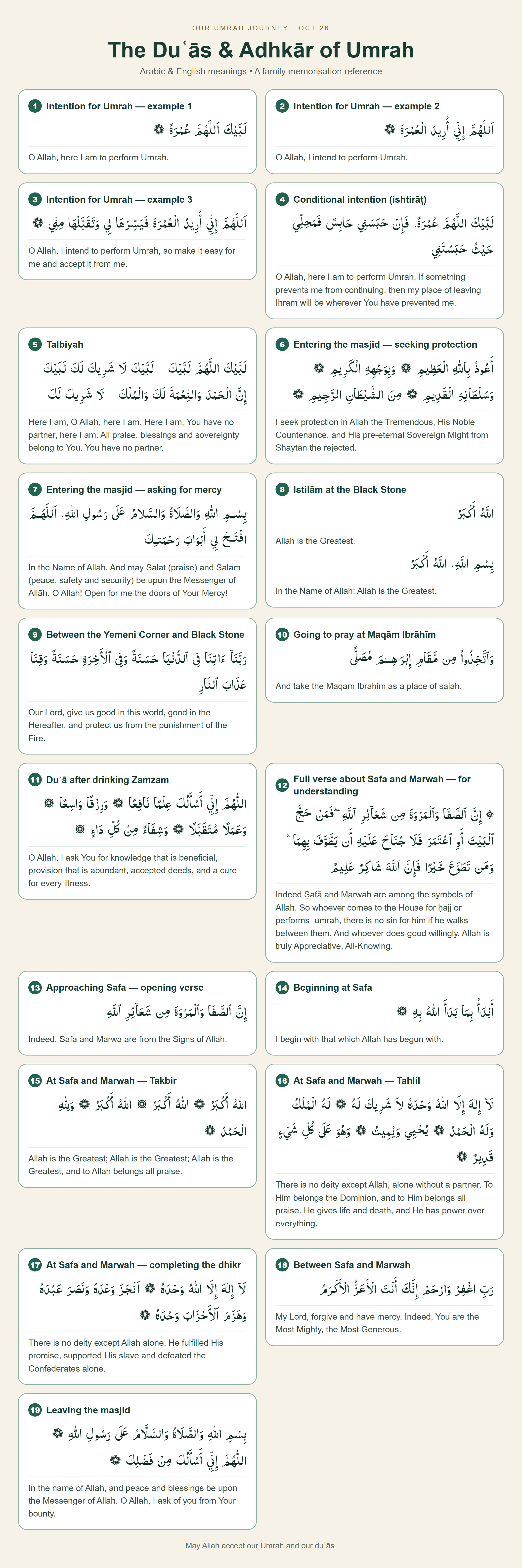
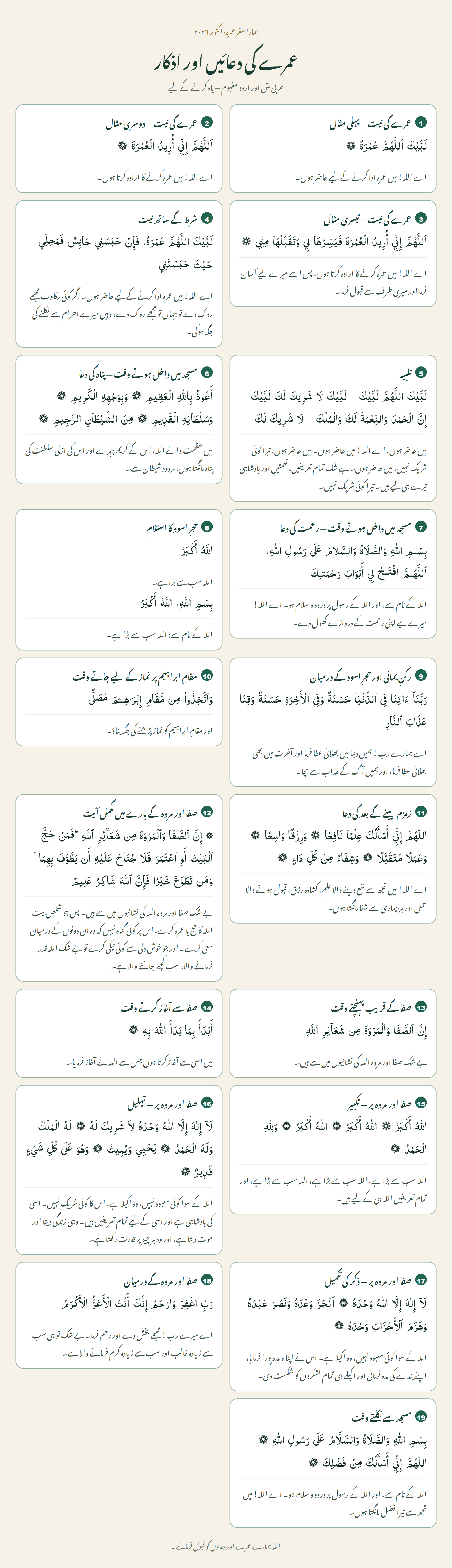
Save all the duʿās as one image
Arabic and English meanings together in a high-resolution reference image. Save it to your phone for memorisation or sharing with the family.
O Allah سُبْحَانَهُوَتَعَالَى, here I am to perform Umrah. If something prevents me from continuing, then my place of leaving Ihram will be wherever You have prevented me.
Here I am, O Allah سُبْحَانَهُوَتَعَالَى, here I am. Here I am, You have no partner, here I am. All praise, blessings and sovereignty belong to You. You have no partner.
Bismillaahi, wassalaatu wassalaamu ‘alaa Rasoolillaahi. Allahum-maftah lee ‘abwaaba rahmatika.
In the Name of Allah سُبْحَانَهُوَتَعَالَى. And may Salat (praise) and Salam (peace, safety and security) be upon the Messenger of Allāh سُبْحَانَهُوَتَعَالَى. O Allah سُبْحَانَهُوَتَعَالَى! Open for me the doors of Your Mercy!
Indeed Ṣafā and Marwah are among the symbols of Allah سُبْحَانَهُوَتَعَالَى. So whoever comes to the House for ḥajj or performs ʿumrah, there is no sin for him if he walks between them. And whoever does good willingly, Allah سُبْحَانَهُوَتَعَالَى is truly Appreciative, All-Knowing.
Allāhu akbar, Allāhu akbar, Allāhu akbar, wa li Llāhi l-ḥamd.
Allah سُبْحَانَهُوَتَعَالَى is the Greatest; Allah سُبْحَانَهُوَتَعَالَى is the Greatest; Allah سُبْحَانَهُوَتَعَالَى is the Greatest, and to Allah سُبْحَانَهُوَتَعَالَى belongs all praise.
La ilāha illa Llāhu waḥdahu la sharīka lah, lahu l-mulku wa lahu l-ḥamd, yuḥīī wa yumīt, wa huwa ʿalā kulli shay’in qadīr.
There is no deity except Allah سُبْحَانَهُوَتَعَالَى, alone without a partner. To Him belongs the Dominion, and to Him belongs all praise. He gives life and death, and He has power over everything.
Bismi Llāhi wa ṣ-ṣalātu wa s-salāmu ʿalā rasūli Llāh. Allāhumma innī as’aluka min faḍlik.
In the name of Allah سُبْحَانَهُوَتَعَالَى, and peace and blessings be upon the Messenger of Allah سُبْحَانَهُوَتَعَالَى. O Allah سُبْحَانَهُوَتَعَالَى, I ask of you from Your bounty.
Personal duʿā in our own words
Ask Allah سُبْحَانَهُوَتَعَالَى for forgiveness, guidance, health, beneficial knowledge, our loved ones, the ummah and Jannah. These examples are personal prayers, not prescribed wording:
“O Allah سُبْحَانَهُوَتَعَالَى, make us among those whose duʿās You accept.”
“O Allah سُبْحَانَهُوَتَعَالَى, accept our Umrah. Thank You for bringing us to Your sacred House. Forgive our shortcomings and help us continue to worship You and be kind to others when we return home.”